


What’s the difference and why should HR bother?
Most HR transformations don’t stall because of technology. They stall because we quietly default back to process thinking.
Across many organisations the same pattern plays out. The system goes live, the modules are configured, governance is tight, the cycle dates are clear. For example:
- Performance reviews happen on time.
- Succession grids are completed.
- Recruitment workflows are compliant.
- Learning completion rates are reported.
On paper, everything is working. However, in leadership meetings the same frustrations continue to be evident:
- “We don’t really know our future skills gap.”
- “Hiring still feels reactive.”
- “We can’t see leadership risk early enough.”
- “We don’t know if performance is truly aligned to strategy.”
This is the quiet gap between process and product.
What process thinking looks and feels like
Process thinking is comforting. It is structured. It has a calendar. It has checkpoints. It asks, quite reasonably:
Did we complete the cycle?
There is a sense of control in that question. HR teams feel organised. Auditors are satisfied. Managers know what’s expected of them. However, over time something subtle happens.
- Performance management becomes “that time of year.”
- Succession becomes a workshop.
- Learning becomes a compliance tracker.
- Recruiting becomes a workflow engine.
The modules start to feel like obligations rather than enablers. Managers comply. Employees participate. HR administers. The system becomes something people move through — not something that moves the organisation forward.
And that’s the fundamental difference, let’s cover that again:
The system becomes something people move through — not something that moves the organisation forward.
Process thinking only gets an organisation so far. It’s not wrong. In fact, in regulated or complex environments, it is essential. It creates consistency and governance. It reduces risk.
However, it rarely creates momentum. In today’s world of expectation and technological proficiency – it’s not enough on its own.
What product thinking changes
Product thinking starts with a different question entirely:
What capability is this designed to strengthen?
Now the conversation shifts.
Performance is no longer about forms and ratings. It is about whether the organisation is measurably sharper, clearer and more aligned than it was last quarter.
- Succession is no longer a static grid >>> it becomes a living view of leadership risk exposure and readiness depth.
- Recruiting stops being a response to vacancies >>> becoming a way of shaping future capability supply.
- Learning becomes less about course attendance >>> more about whether skill gaps are shrinking.
- Career development stops being an aspiration form >>> becoming a mechanism for internal mobility and retention.
When you operate this way, the modules start to feel different inside the organisation. Managers don’t dread the cycle — they use it. Employees don’t fill in profiles — they see pathways. Executives don’t ask HR for reports — they rely on HR for capability insight.
The processes and technology haven’t changed. The intent has.
Why this matters now more than ever
In sectors facing demographic shifts, digital disruption, efficiency drivers, infrastructure renewal or AI-led redesign, capability gaps are no longer theoretical risks. They are operational realities, for example:
- An ageing engineering workforce.
- A shortage of digital skills.
- Leadership pipelines that are thinner than assumed.
If your talent modules are only running cycles, they cannot respond fast enough to those shifts.
The million dollar question: how to begin the shift
It doesn’t start with reconfiguration. It starts with reframing. Before you open a module, pause and ask:
What would “success” look like if this was working brilliantly?
- For performance, perhaps it is visible strategic alignment and fewer surprise underperformance cases.
- For succession, perhaps it is knowing — at any moment — how exposed you are if a critical leader leaves.
- For learning, it might be watching a measurable digital capability curve rise across the organisation.
Once you can describe the outcome in human and commercial terms, the system begins to serve a purpose beyond administration.
Another shift is ownership.
- Process leads manage timelines.
- Product owners manage value.
A product owner worries about adoption quality, user experience, data integrity and whether the intended capability is strengthening over time. They look at trends, not just deadlines. They ask uncomfortable questions about impact. They own the end-to-end add up of the processes put together.
Without that ownership, even the best-configured system and process drifts back into compliance mode.
The measurement shift
This is often where many organisations hesitate. Completion rates are reassuring as they are easy to report and probably something that is already in place.
However product thinking pushes further. For example, metrics about the following become more important and insightful:
- Are internal mobility rates increasing?
- Is bench strength deepening?
- Are we reducing time-to-productivity for critical hires?
- Are we closing skill gaps that matter commercially?
These questions are less comfortable. Although, they are the ones that connect HR to enterprise value.
The human shift
Perhaps the most important shift, though, is human. Product thinking is empathetic, as it asks how something feels to use.
- Does a manager experience clarity or burden?
- Does an employee experience growth or bureaucracy?
- Does a recruiter feel strategic or transactional?
If your talent modules feel heavy, they will never be strategic — no matter how elegant the configuration. When they feel intuitive and purposeful, behaviour changes. Therefore, when behaviour changes capability follows.
From modules to a Talent Portfolio
To bring this to life, the most mature organisations stop viewing Performance, Succession, Recruiting and Learning as separate systems. Alternatively, they see them as a portfolio of interconnected products.
- Performance data informs succession readiness.
- Succession gaps drive targeted learning.
- Learning builds skills that reduce external hiring demand.
- Career pathways fuel internal mobility.
It becomes an ecosystem — not a checklist. That is when HR moves from service provider to capability architect.
The real question?
So here is the test.
If your technology environment stopped running tomorrow, would leaders feel administrative disruption — or strategic blindness?
- If it’s the former, you’re running processes.
- If it’s the latter, you’re running products.
It is this question that truly identifies the difference between operating HR systems that focus on process or have shifted to product.
The HR Fixers’ difference
The future of HR isn’t about running better cycles. It’s about building stronger organisations and HR should be leading this from the front. It’s time to evolve how HR operates in order to strategically support the organisation, and we know how to do this in practice and in reality.
At The HR Fixers, we’re seeing a renewed focus on the strategic value of HR Shared Services (HRSS), not just as a cost-saving tool, but as a driver of agility, employee experience, and operational efficiency.
In today’s dynamic business environment, organisations are increasingly moving towards centralised HR delivery models to respond faster to workforce needs, manage compliance at scale, and create seamless service experiences. Shared Services is often at the heart of this transformation.
Let’s explore what Shared Services in HR really means, the capabilities it brings, the types of services and roles it involves, and how to navigate the challenges and competing priorities.
What is HR Shared Services?
HR Shared Services (HRSS) is a centralised model for delivering routine, transactional, and standardised HR activities. Instead of every business unit or location managing its own HR admin tasks, Shared Services consolidates them into one team or platform – improving consistency, efficiency, and employee satisfaction.
This model often sits alongside Centres of Expertise (COEs) for deep functional expertise (e.g., Reward or Talent), and HR Business Partners (HRBPs) who remain embedded in the business.
Capabilities in HR Shared Services
HR Shared Services isn’t just about processing forms or answering employee questions. Modern Shared Services teams are equipped with capabilities such as:
- Case and knowledge management: managing employee queries through tools like ticketing systems and knowledge bases.
- Automation and workflow: automating high volume, repeatable tasks like onboarding, document generation, and approval flows. So Advisors can focus on the complex, human-centred cases.
- Collaboration, through people insights and reporting: providing accurate HR data, dashboards, and compliance reporting. Servicing HRBPs will insightful data to drive an optimise workforce and remove concerning trends around sickness, wellbeing or poor performance.
- Service Delivery Channels: supporting omnichannel access – email, phone, self-service portals, chatbots so the whole workforce can access services no matter where they are.
- Continuous Improvement: using feedback and service metrics (SLAs, NPS) to refine and evolve service delivery.
Types of services in HR Shared Services
Shared Services typically handles a broad scope of transactional and advisory support, including:
- Employee Lifecycle Services: recruitment, onboarding, offboarding, contract changes, role moves, secondments.
- Payroll and Benefits Administration: data input, adjustments, deductions, enrolment queries.
- HR Systems and Data Management: maintaining employee records, ensuring data integrity across platforms like SAP SuccessFactors or Workday or Hi Bob.
- Policy Guidance and Tier 1 Advice: supporting employees and managers with basic interpretation of HR policies.
- Leave and Absence Administration: managing maternity/paternity/parental leave, sick leave, holiday accruals.
- Training Administration: learning catalogue maintenance, training request processing, scheduling, payments & record maintenance
- Employment Verification and Documentation: producing letters, contracts, visa support, etc.
Roles in HR Shared Services
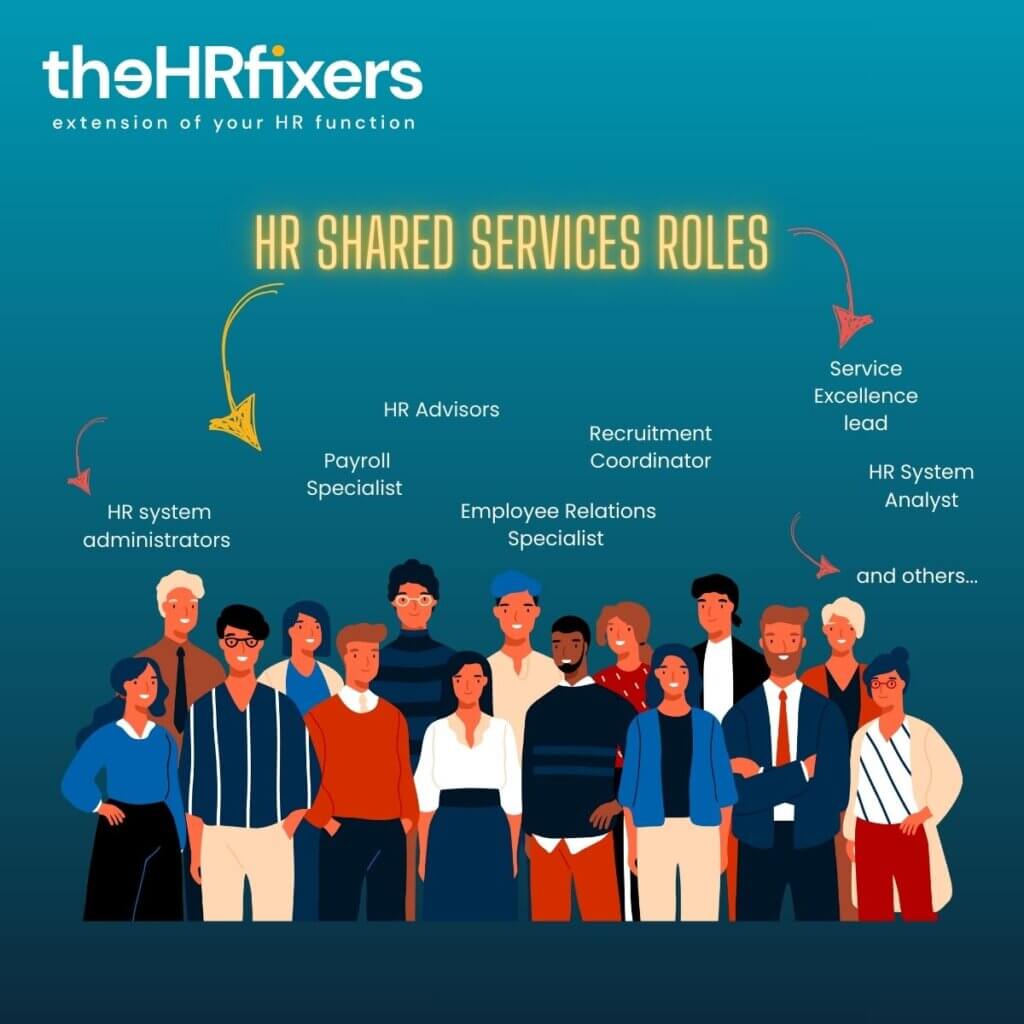
- HR Service Advisors (Tier 1 Support): first point of contact for queries, managing tickets and knowledge articles.
- HR Specialists (Tier 2 Support): handling complex or escalated cases (e.g., international assignments, complex leave scenarios). This is a growing field of expertise.
- HR Systems Administrators: managing system configurations, user access, workflows, and integrations.
- Shared Services Team Leads and Managers: overseeing team performance, service levels, continuous improvement.
- Service Excellence Leads: driving process optimisation and employee experience enhancements.
The Challenges and competing priorities
Despite the benefits, Shared Services doesn’t come without hurdles:
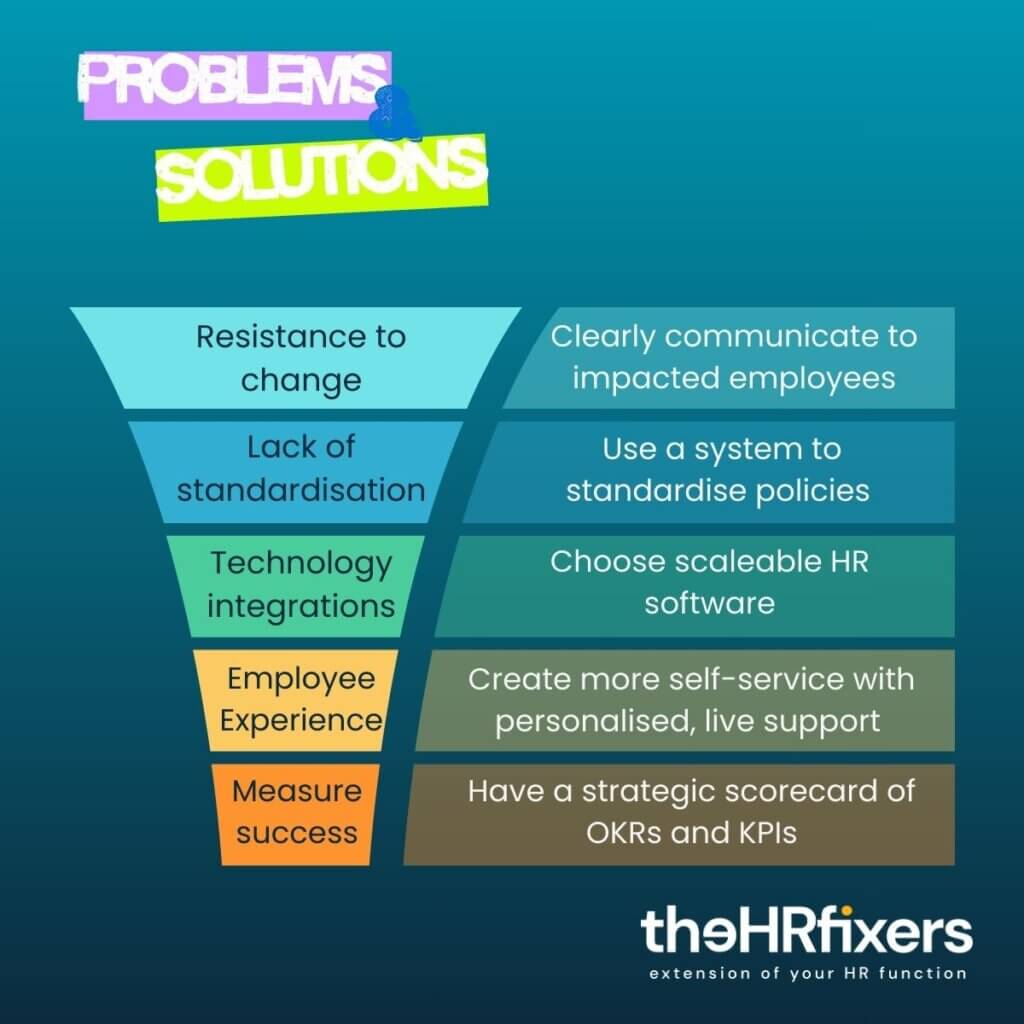
🚧 Balancing Standardisation vs. Local Needs: multinational organisations often struggle to apply global processes while respecting local legal and cultural nuances.
🚧 Adoption of Self-Service: encouraging employees and managers to use self-service tools can be a slow and uneven journey. Causing over-reliance on the Advisors and lots of tickets, leading to slow turnaround times.
🚧 Fragmented Technology Ecosystems: integrating data and processes across multiple HR systems, legacy tools, and manual workarounds can dilute efficiency.
🚧 Change Resistance: business units may resist centralisation, fearing loss of control or reduced service quality.
🚧 Service Metrics vs. Experience: meeting SLAs doesn’t always equate to a great employee experience. Balancing efficiency with empathy is critical.
🚧 Talent Development in Shared Services: ensuring Shared Services roles offer growth and career progression opportunities remains a challenge in many organisations.
Where to start?
Organisations looking to unlock the full potential of HR Shared Services should:
Start with the operating model: how will the work be done (why start here, read our blog about Operating models first, structure second).
- Determine the services this team needs to provide.
- Determine the capabilities required to offer these services.
- Design processes around the employee journey, not internal convenience.
- Invest in enabling technology and automation.
- Design a scorecard that captures the outcomes to be delivered. Tracking trends and root cause improvement over time.
Move to the org: who will do the work.
- Define clear roles to deliver these services.
- Link to values and culture to ensure collaboration.
- Enable empowered leaders who will own the service offering and cascade key messages.
- Ensure communication across the function is organised, alongside channels to communicate to the wider business
Use data and opportunities to listen and gather feedback, to continuously refine services.
- From within the team
- From across the business
The HR Fixers’ difference
At The HR Fixers, we help organisations reimagine their HR service delivery – from operating models, service proposition, to system optimisation. Whether you’re setting up your Shared Services model or enhancing an existing one, we can help you align service delivery with employee expectations and business strategy.
Let’s fix HR for the future.
When performance lags or challenges mount, leaders often reach for a familiar lever: restructuring.
It’s tempting! Move a few boxes on the org chart, realign reporting lines, and hope that a new configuration unlocks better results. More often than not, this approach fails to address the root cause of dysfunction. The real culprit? A flawed operating model.
What’s an operating model
An operating model defines how work gets done.
Not who, but how.
- The processes, governance, tools, and culture that underpin daily operations.
- It’s the engine beneath the structure, shaping how teams collaborate, make decisions, and deliver value.
Without a well-designed operating model, even the most perfectly structured team will struggle to perform.
Why restructuring falls short
Restructuring often focuses on hierarchy rather than flow. It answers the question, “Who reports to whom?” rather than “How does work move efficiently from idea to impact?”
This narrow focus overlooks bottlenecks, duplication, misaligned incentives, and cumbersome, manual processes that remain untouched, regardless of team configuration.
Limitations
➡️ It’s a short-term fix: restructuring teams addresses symptoms rather than root cause. Without transforming the operating model, underlying inefficiencies may persist.
➡️Limited scalability: while effective for small-scale adjustments, team restructuring may not be sustainable for long-term growth or significant strategic pivots.
➡️ Siloed thinking: realigning teams without altering organisational processes or systems can reinforce silos and duplication, hindering cross-departmental collaboration and real efficiency gains.
➡️Leadership confusion: shifting reporting lines and responsibilities can create confusion and uncertainty among leadership, impacting decision-making. Whilst the restructure happens, there is often inertia and some of the best processes and innovation get lost.
➡️Cultural resistance: here we go again… even team-level changes can face resistance if employees perceive them as frequent or arbitrary, with little to no benefit.
This last point is significant and shouldn’t be underestimated, so we’ll say it twice – constant restructuring can breed instability. Employees experience change fatigue, morale dips, and productivity suffers as they navigate new relationships and unclear expectations. Without addressing how the work itself is organised and executed, the same problems resurface – just under different reporting lines.
Model first, structure second
The hard path is often the right one, although rarely taken. Too often leaders jump to a restructure of teams to improve efficiency. This is the quick answer, that on the surface shows action and possible short-term cost reductions. However, it has limited benefit, no longevity and it rarely delivers actual improvements over the medium to long-term.

The inefficiencies and problems aren’t resolved, just moved.
The brave path, the longer and harder path to efficiency is the right one. This choice enables the Leader to listen to the teams and look at the way they operate – the processes they follow and the data analytics, tools and tech they rely on. If they are not fit-for-future, then neither is the structure.
Focusing on the operating model shifts attention from structure to substance. A strong operating model clarifies these key questions:
- Processes: are workflows streamlined, consistent, and designed for efficiency?
- Decision-making: who has the authority to make which decisions, and how are they communicated?
- Technology and tools: do employees have the resources they need to perform effectively?
- Culture and behaviours: are collaboration, accountability and continuous improvement embedded in daily work?
A well-functioning operating model creates clarity, reduces friction, and empowers teams to perform – regardless of how the org chart looks. Before you shuffle roles and reporting lines, take a step back and ask:
Is it the team that’s broken, or the way they’re being asked to work?
Fix the model, and the rest will follow
CPCO and CHRO leaders have a critical role in ensuring the organisation understands the value of the operating model and how it can be continuously improved to be more effective and efficient. They are the conscience and custodians, who help other Executives see the light ahead. The old way, the easy way, is no longer the right way.
Start with the operating model. Stop shuffling, start solving!
The HR Fixers’ difference
Refreshing the operating model isn’t easy, which is why so many Leaders shy away from it when it really matters. We’ve seen it done poorly and we’ve helped teams do it really well.
It’s not an overnight job. We partner with you and act as an extension of your HR team, helping you every step of the way.
We listen to your team, take time to understand how they work and identify the processes, data and tools that they use. Together we design a better way of working, in a fit-for-purpose operating model.