


When performance lags or challenges mount, leaders often reach for a familiar lever: restructuring.
It’s tempting! Move a few boxes on the org chart, realign reporting lines, and hope that a new configuration unlocks better results. More often than not, this approach fails to address the root cause of dysfunction. The real culprit? A flawed operating model.
What’s an operating model
An operating model defines how work gets done.
Not who, but how.
- The processes, governance, tools, and culture that underpin daily operations.
- It’s the engine beneath the structure, shaping how teams collaborate, make decisions, and deliver value.
Without a well-designed operating model, even the most perfectly structured team will struggle to perform.
Why restructuring falls short
Restructuring often focuses on hierarchy rather than flow. It answers the question, “Who reports to whom?” rather than “How does work move efficiently from idea to impact?”
This narrow focus overlooks bottlenecks, duplication, misaligned incentives, and cumbersome, manual processes that remain untouched, regardless of team configuration.
Limitations
➡️ It’s a short-term fix: restructuring teams addresses symptoms rather than root cause. Without transforming the operating model, underlying inefficiencies may persist.
➡️Limited scalability: while effective for small-scale adjustments, team restructuring may not be sustainable for long-term growth or significant strategic pivots.
➡️ Siloed thinking: realigning teams without altering organisational processes or systems can reinforce silos and duplication, hindering cross-departmental collaboration and real efficiency gains.
➡️Leadership confusion: shifting reporting lines and responsibilities can create confusion and uncertainty among leadership, impacting decision-making. Whilst the restructure happens, there is often inertia and some of the best processes and innovation get lost.
➡️Cultural resistance: here we go again… even team-level changes can face resistance if employees perceive them as frequent or arbitrary, with little to no benefit.
This last point is significant and shouldn’t be underestimated, so we’ll say it twice – constant restructuring can breed instability. Employees experience change fatigue, morale dips, and productivity suffers as they navigate new relationships and unclear expectations. Without addressing how the work itself is organised and executed, the same problems resurface – just under different reporting lines.
Model first, structure second
The hard path is often the right one, although rarely taken. Too often leaders jump to a restructure of teams to improve efficiency. This is the quick answer, that on the surface shows action and possible short-term cost reductions. However, it has limited benefit, no longevity and it rarely delivers actual improvements over the medium to long-term.

The inefficiencies and problems aren’t resolved, just moved.
The brave path, the longer and harder path to efficiency is the right one. This choice enables the Leader to listen to the teams and look at the way they operate – the processes they follow and the data analytics, tools and tech they rely on. If they are not fit-for-future, then neither is the structure.
Focusing on the operating model shifts attention from structure to substance. A strong operating model clarifies these key questions:
- Processes: are workflows streamlined, consistent, and designed for efficiency?
- Decision-making: who has the authority to make which decisions, and how are they communicated?
- Technology and tools: do employees have the resources they need to perform effectively?
- Culture and behaviours: are collaboration, accountability and continuous improvement embedded in daily work?
A well-functioning operating model creates clarity, reduces friction, and empowers teams to perform – regardless of how the org chart looks. Before you shuffle roles and reporting lines, take a step back and ask:
Is it the team that’s broken, or the way they’re being asked to work?
Fix the model, and the rest will follow
CPCO and CHRO leaders have a critical role in ensuring the organisation understands the value of the operating model and how it can be continuously improved to be more effective and efficient. They are the conscience and custodians, who help other Executives see the light ahead. The old way, the easy way, is no longer the right way.
Start with the operating model. Stop shuffling, start solving!
The HR Fixers’ difference
Refreshing the operating model isn’t easy, which is why so many Leaders shy away from it when it really matters. We’ve seen it done poorly and we’ve helped teams do it really well.
It’s not an overnight job. We partner with you and act as an extension of your HR team, helping you every step of the way.
We listen to your team, take time to understand how they work and identify the processes, data and tools that they use. Together we design a better way of working, in a fit-for-purpose operating model.
Reach out to see how we can support you.
HR transformation doesn’t end at go-live. True success is measured by how well organisations sustain, optimise, and evolve their HR operations through BAU. That’s where Elevate comes in.
The HR Fixers’ Elevate service is designed to embed continuous improvement, ensuring that HR technology, processes and people continue to deliver value long after implementation.
Why Elevate?
Many businesses invest in HR transformation yet fail to fully realise its long-term benefits. Historically, after implementation is where the benefits are maximised, however so often the focus is lost, and project team members drift off. Not us. We stick around to make sure you see and feel the value from the HR shift.
Without ongoing optimisation, new systems and processes can become underutilised, adoption rates decline, and strategic impact diminishes.
With Elevate, we ensure your HR function doesn’t just adapt to change — it thrives in it. We work alongside your team to embed best practices, enhance efficiency, and drive continuous improvements that keep HR future-ready.
What does Elevate include?
- Continuous improvement: we analyse and refine HR processes, ensuring systems and workflows evolve with business needs.
- People analytics and science: leveraging workforce analytics to provide actionable insights, improving decision-making and workforce planning.
- Leadership enablement: we provide ongoing coaching, training, and advisory support to upskill HR teams and leaders. Enabling them to thrive!
- Adoption and innovation: ensuring HR technology is fully utilised, with regular updates and enhancements for maximum efficiency. Bringing the latest innovations for you to test and try.
- HR strategy alignment: keeping HR initiatives aligned with evolving business goals, so that HR remains a driving force for organisational success, time and time again.
Beyond maintenance: driving lasting impact
Sustained HR success isn’t about maintaining the status quo — it’s about continuously evolving to meet new challenges. With Elevate, we help businesses stay ahead, creating an HR function that is agile, efficient, and strategically aligned.
The HR Fixers’ difference
We don’t believe in ‘one-and-done’ projects. Our approach ensures that your HR transformation delivers lasting value, with a focus on people, process, and performance. We are not just consultants — we are long-term partners in your success.
Ready to Elevate your HR function?
If you’re looking to optimise, innovate, and future-proof your HR operations, The HR Fixers’ Elevate service is the next step. Let’s take HR to the next level together. Contact us today to learn more!
As a Chief People and Culture Officer (CPCO) or Chief HR Officer (CHRO), you’ve navigated the initial phase of understanding the case for change to HR’s processes, tech and data that your people use. Now it’s time to build that future.
Building future-ready HR
HR transformation doesn’t stop at strategy — it’s about turning vision into action. After defining the roadmap with Navigate, the next step is to bring that transformation to life. That’s where Build comes in.
The HR Fixers’ Build service is designed to help organisations implement their HR strategy with precision, ensuring that technology, processes, data and people are aligned for long-term success.
Why Build?
Many HR transformation projects struggle in execution. Whether it’s a lack of internal expertise, unclear responsibilities, or resistance to change, businesses often find themselves stuck between strategy and implementation.
With Build, we bridge that gap.
We work as an extension of your HR team, rolling up our sleeves to manage the end-to-end delivery of your HR transformation — so that your vision becomes a reality.
Whilst you focus on ‘running‘ the function, we support the parallel ‘change‘ activity. To help you move forward, together we simply take one step after another, along the roadmap of change. After all, the organisation can’t stop whilst HR builds the future – they have to be done in parallel. That’s the gap we bridge.
What does Build include?
The Build phase is the chunky bit of the programme — it’s where design becomes reality. Here our expertise shines. We manage the transformation and guide teams through the detail or where they lack confidence.
- Programme oversight and strategic advisory: we manage the transformation process, ensuring all moving parts align with your strategic goals.
- Process alignment and business readiness: we work with your teams to map out optimised HR workflows, ensuring your people and operations are prepared for change.
- System implementation support: from guiding HRIS configurations to liaising with technology partners, we ensure a smooth and effective system rollout.
- Data readiness and cleansing: ensuring your HR data is clean, accurate, and ready for migration is crucial for a smooth transition.
- Testing readiness: from developing test scripts, to running sessions with end-users to test the new processes and the system. We support you every step of the way, as your people try out the new ways of working for the first time.
- Change, training and adoption: we develop and execute change management plans to ensure employees embrace new ways of working and they stick! Through engaging communications about the ‘why‘ and the ‘what‘, and effective training sessions using innovative tools to keep it interesting, we help end-user understand the impact of this change and embrace it.
Beyond implementation: A strong foundation for growth
A successful HR transformation isn’t just about going live — it’s about embedding new ways of working that add long-term value. Our Build approach ensures that systems are fully adopted, processes are optimised, data is used with confidence to drive insightful decisions, and the HR team has solid foundations on which to build the future.
The HR Fixers’ difference
Unlike traditional consultancies that leave after implementation, we continue to support you to make sure it works. Our hands-on approach ensures that technology is not just implemented but optimised and fully leveraged to meet your business needs. This is where ‘run‘ and ‘change‘ meet, so that this new way of working is absorbed into the day-to-day running of the function.
Ready to build a stronger HR function?
If you’re looking for a partner who can turn HR strategy into real, lasting impact, The HR Fixers’ Build service is here to help.
Let’s build the future of HR together. Contact us today to get started!
HR transformation is a journey — but before you begin, you need a clear roadmap. Understanding the why, where, what and how of change is critical to a successful transformation. That’s where DiscoveryLite comes in.
DiscoveryLite is our fast-track readiness assessment, designed to help HR leaders quickly define their transformation strategy and set up for success. We provide clarity, structure, and expert insights to ensure your people technology programme starts on the right track – all within a week.
Why DiscoveryLite?
Starting an HR transformation without a clear plan can lead to misalignment, inefficiencies, and resistance to change. Many organisations struggle with stakeholder alignment, unclear scope, and undefined responsibilities.
With DiscoveryLite, we help you plot the course for success — engaging key stakeholders, defining priorities, and ensuring your organisation is ready for change.
What Does DiscoveryLite Include?
- Readiness recommendations: providing actionable insights to address gaps before launching your transformation.
- Scope and roadmap clarity: mapping out what’s in and out of scope and building a high-level delivery plan.
- Technology vision and future state: defining the target technology landscape and capabilities needed.
- Stakeholder alignment: engaging HR, IT, Finance, and business leaders to ensure everyone is on the same page.
- Roles and responsibilities: clarifying internal and external responsibilities to identify resource needs.
- Project planning and risk assessment: creating a structured plan with RAID (Risks, Assumptions, Issues, Dependencies) insights to mitigate potential blockers.
DiscoveryLite doesn’t just help you assess readiness — it sets you up to Navigate, Build, and Elevate your HR transformation with confidence.
The HR Fixers’ Difference
We don’t just deliver reports — we work with you to co-create a plan that works for your business context. Our hands-on, practical approach ensures that your HR transformation is grounded in reality and built for success.
Ready to Get Started?
If you’re preparing for an HR transformation, DiscoveryLite is the first step toward a clear, structured, and effective change journey.
Let’s define your path forward. Contact us today to kickstart your HR transformation!
In today’s fast-paced business environment, transformation is a constant. Whether it’s adapting to new technologies, evolving company culture, or implementing strategic HR initiatives, Chief People & Culture Officers (CPCOs) are at the forefront of change. However, too often, we see these transformations managed as isolated initiatives — HR digitalisation over here, a DEI strategy over there, and leadership development somewhere in the mix.
The problem?
Managing transformation in silos leads to inefficiencies, misalignment, and a failure to deliver sustainable impact. Instead, CPCOs must approach transformation as a portfolio of projects, ensuring strategic alignment, resource optimisation, and long-term success. However, so often HR teams are already overloaded by the day job.
How can they possibly manage, guide and sponsor change on top?
The pitfalls of managing HR transformation in isolation
When HR transformation initiatives are managed separately, several common challenges emerge:
1. Lack of visibility
A suite of projects that don’t make visible the holistic add-up can be confusing for stakeholders and lead to duplication. For the CPCO, this can lead to a disjointed narrative and an inability to see the combined benefits being delivered. Investment in HR is challenging to secure at the best of times, so when you get it – keep it! Make the work, outcomes and benefits easily visible for everyone, through a portfolio management approach.
2. Lack of alignment
HR initiatives often tie into broader business goals like growth, efficiency, and employee engagement. When transformation projects are treated as standalone efforts, they may not align with overarching corporate objectives. For example, implementing an AI-driven recruitment tool without integrating it into the company’s talent strategy can result in inefficiencies rather than improvements.
3. Competing priorities and resource constraints
HR teams have limited time, budgets, and people. When multiple initiatives are launched independently, they often compete for resources, leading to delays or half-baked implementations. A leadership development program might lose momentum because all resources have shifted to an HR tech rollout — leaving both initiatives under-delivering. The HR team don’t have the extra time (or skill or capability sometimes) to resource all the change, on top of the day job.
4. Change fatigue and resistance
Employees and managers can only handle so much change at once. When transformation initiatives roll out in silos, employees feel like they are constantly being hit with new processes and tools without understanding the bigger picture. This can lead to resistance, disengagement, and a failure to fully embed the changes. The same can be said of the team leading it, those within HR – unless the portfolio is well planned, easily communicated and everyone is bought into the ‘why’ and ‘how’.
5. Missed opportunities for synergy
HR initiatives are often interconnected:
- Performance management ties into leadership development.
- Employee experience links to digital HR tools.
- DEI efforts impact recruitment and retention.
When projects are managed separately, organisations miss opportunities to leverage insights, integrate technologies, and drive cohesive cultural change. The communications plan that underpins this change needs a synchronised portfolio to knit together the story and help make the change stick.
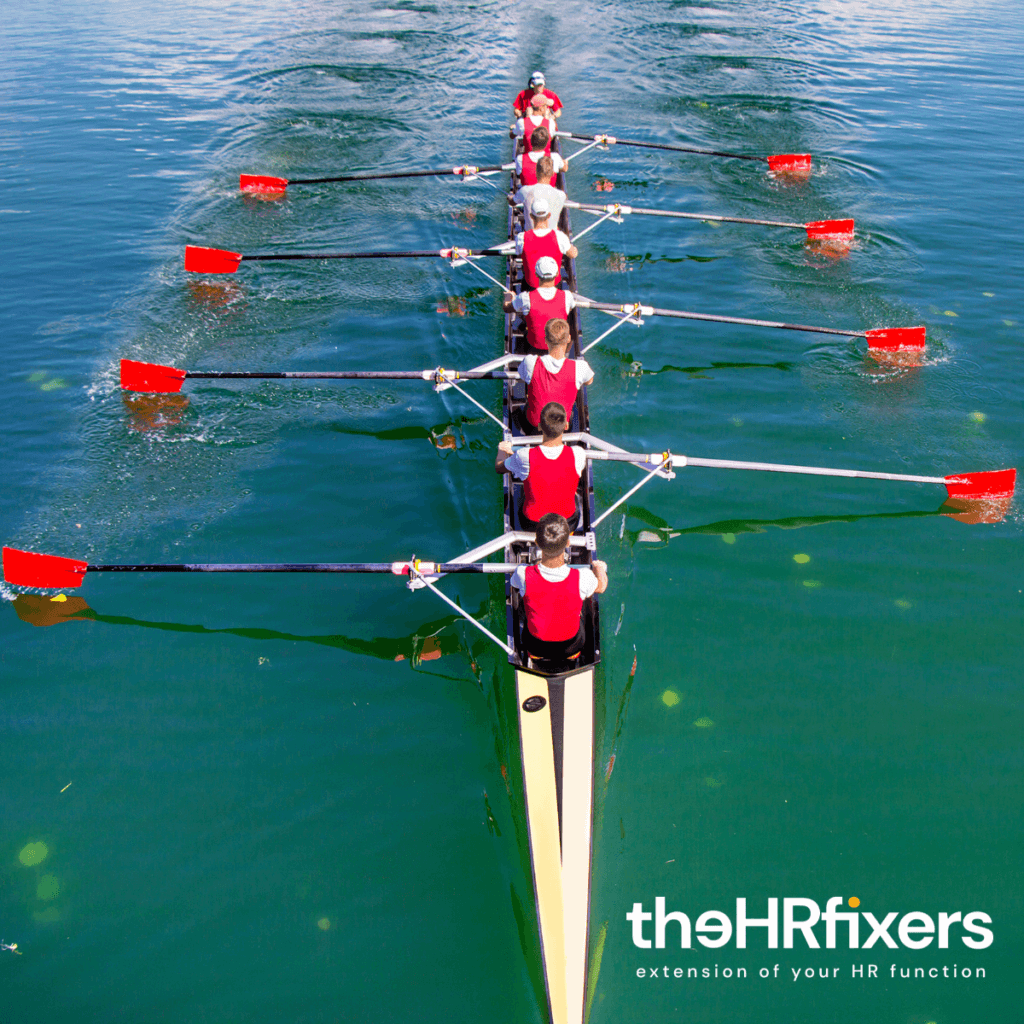
These pitfalls are similar to everyone jumping in a boat, grabbing an oar and pulling in their own direction, whilst the cox-person shouts random instructions at no-one in particular.
Wouldn’t it be better, if everyone sat comfortably in the same boat, pulled in synchronicity, following a clear plan, to aim for the win?
Managing a portfolio of HR initiatives
To avoid these pitfalls, CPCOs should take a portfolio approach to transformation. This means viewing all HR initiatives and projects, as interconnected deliverables within a larger transformation roadmap, ensuring they work together to deliver business outcomes.
Use an excerpt from our NAVIGATE phase, to ensure the key steps to portfolio management in an HR Transformation are set up for success:
1. Define the strategic vision
Start by identifying the overarching people strategy and how different transformation initiatives contribute to that vision. Ensure that every project aligns with the business’s long-term objectives. It doesn’t need to be rocket science, a vision maybe as simple as:
TOP TIP :
- To transform HR into a strategic powerhouse that enhances employee experience, fosters innovation, and supports agile business growth.
- Building a digitally enabled, insight-driven HR function that empowers people, optimises processes, and drives organisational excellence.
- Shaping a high-performing, inclusive, and adaptable HR ecosystem that attracts, develops, and retains top talent through innovation and continuous improvement.
2. Prioritise and sequence initiatives
Not all projects need to be executed at once. Map out initiatives based on urgency, impact, and dependencies. This prevents resource strain and ensures smooth implementation.
TOP TIP:
- A great way to do this is to engage the team and ask them to prioritise the list of initiatives based on their view of benefit to be delivered.
- A bottom-up approach instead of top-down.
- This approach is powerful to secure team buy-in.
3. Streamline governance and oversight
Appoint a transformation steering committee or a dedicated team to get visibility of the whole portfolio. This group ensures alignment, tracks progress, celebrates success and makes decisions to course-correct when needed.
TOP TIP:
- Make it the one meeting a month they don’t ever miss!
4. Integrate technology and data
HR tech implementations should not happen in isolation. Integrate new tools with existing systems to create a seamless digital employee experience. Use valuable data to measure the benefit of transformation initiatives and adjust as needed.
TOP TIP:
- Identify how you measure success early in the governance cycle.
- Use these metrics to track how it’s going, and adjust them as the portfolio evolves.
5. Support with a strong story
Take a proactive approach to change management, through a compelling story. The internal comms team can help develop this narrative to ensure employees understand how different initiatives connect to the bigger picture. Clear communication, leadership visibility to champion the change, and employee engagement communications are crucial for success.
The HR Fixers’ take
At The HR Fixers, we help organisations shift from fragmented HR projects to strategic, interconnected transformation portfolios. Whether you’re implementing SAP SuccessFactors, redefining your talent strategy, or driving cultural change, we ensure your HR transformation delivers long-term value that everyone can see.
Are you ready to rethink how you manage transformation? Let’s fix it together.
#HRTransformation #PeopleStrategy #TheHRFixers #CPCO #CHRO